
Evidence should help another person follow the disputed decision. More files are not automatically better. A withdrawal confirmation, the relevant support reply and a clear timeline can answer more than twenty cropped screenshots with no dates. Before uploading anything, identify the question each record answers and whether it belongs in a public discussion or a private verification channel.
This guide covers how to collect, organise and share records for any casino dispute. The specific records that matter depend on the problem, and each problem guide lists them. Here the focus is on doing it properly: capturing records that hold up, keeping originals safe, removing private information from public copies and presenting the result so that a stranger can understand it.
Start with the questions your case needs to answer
For a delayed withdrawal, the questions might be when it was requested, whether it was approved and whether payment reached you. For a bonus deduction, they might concern the accepted terms and the transaction said to breach them. For an account closure, they may concern the notice and the decision about the remaining balance. Use those questions as headings in your own notes.
Under each heading, list what you have and what is missing. Be honest about gaps. An email saying a payment was initiated does not replace a receipt, and a screenshot of a balance does not show how every part of that balance was earned. Naming the missing record lets the casino or case manager request it directly.
Which records matter for which problem
| Problem | Records that usually decide it | Guide |
|---|---|---|
| Delayed withdrawal | Request confirmation, status changes, payment-method terms, provider reference | Withdrawal delayed |
| Verification | Each request, submission date and result; the reason for any rejection | KYC requests |
| Blocked account | Restriction notice, last visible balance, the term relied on | Account blocked |
| Bonus deduction | Offer terms as accepted, bet history, balance before and after | Bonus disputes |
| Missing deposit | Bank or wallet entry, cashier status, deposit instructions, transaction reference | Missing deposit |
Capture records so they hold up
How a record was captured affects how much weight it carries. A few habits make a large difference:
- Screenshots: include the address bar and your device's clock where possible, so the domain and time are visible. Capture the whole relevant screen rather than a cropped fragment.
- Live chat: use the transcript or “email me this chat” option before closing the window. If none exists, screenshot the full conversation in order.
- Emails: keep the original message in your mailbox. When you need a copy, save or print it as a PDF that shows the sender address and date.
- Account statements: download the casino's transaction history and your bank's statement for the relevant period as files, not just screenshots.
- Terms and promotions: save the page as a PDF with the date visible. A public web archive snapshot can help show what a page said on a given day.
Capture early. Cashier views, chat histories and terms pages can change or disappear, especially once an account is restricted.
Keep originals and public copies separate
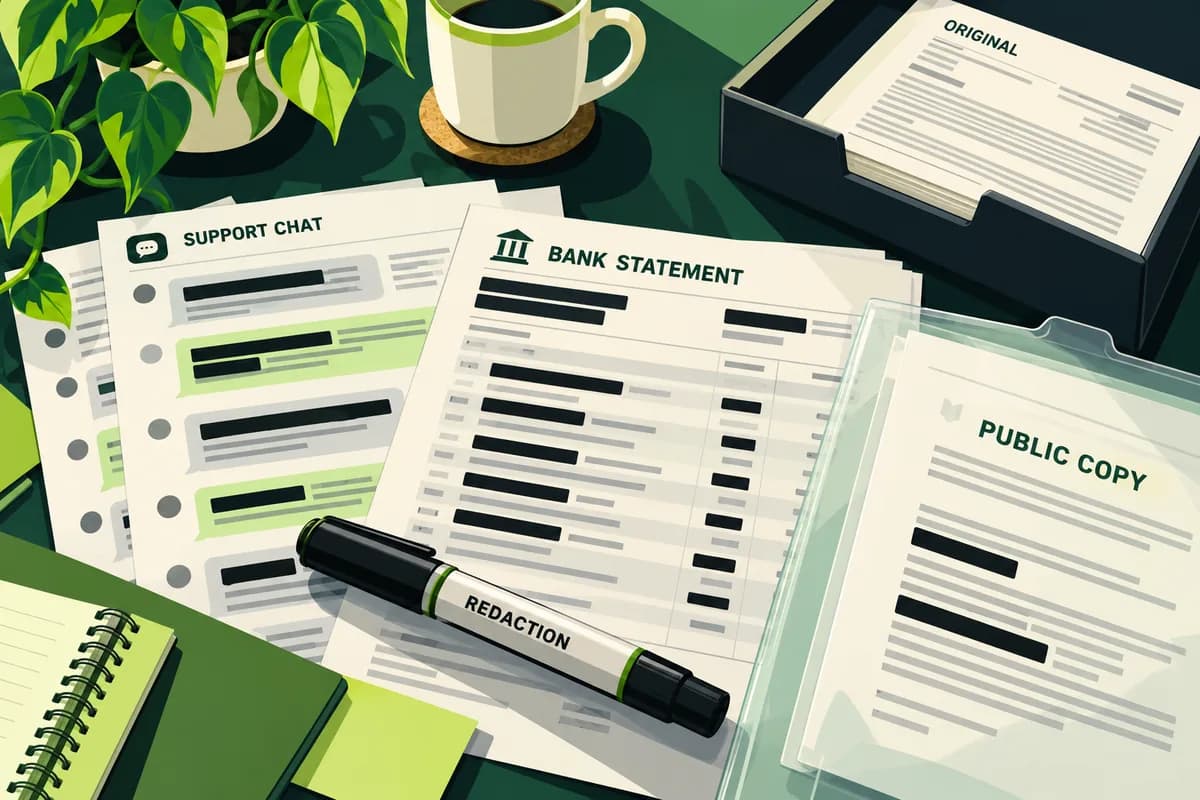
Retain original emails, downloaded statements and screenshots in a private folder. Create a second folder for public copies. Give each copy a descriptive filename such as “withdrawal-request-2026-10-03” without your email, full account number or document number. Record which original it came from so you can supply an intact version through an appropriate private channel if needed.
Do not edit an amount, date or message to make the case look clearer. If you add a visual label, make it obvious that the label is your annotation. Preserve enough of the surrounding conversation to show what the reply refers to. A tightly cropped sentence can reverse the apparent meaning of a support exchange even if the sentence itself is authentic.
Remove private information from the public copy
Check names, email addresses, postal addresses, phone numbers, bank and card details, identity numbers and unrelated transactions. Consider other people's details as well as your own. A chat screenshot can include an agent's personal contact information or another customer's data accidentally displayed by the sender. Public readers generally need the role and relevant reply, not private identifiers.
| Usually keep visible | Usually remove |
|---|---|
| Casino name and domain | Your full name, email and phone number |
| Dates, times and amounts in dispute | Full card, bank account and wallet numbers |
| Status wording in the cashier | Identity document numbers and images |
| The text of the casino's reply | Postal address and date of birth |
| The last few characters of a reference, if useful | Unrelated transactions and other people's details |
Redaction must remove information, not merely cover its appearance. The ICO's guidance explains the risks of hidden personal information in documents and the need to check files before disclosure. A coloured rectangle in a PDF may leave selectable text underneath. Use a tool with a genuine redaction function, or convert the redacted page to an image and back so that no text layer survives.
Check the redaction before you publish
- Reopen the exported public copy and try to select, copy or search for the text you removed.
- Check every page, not only the first one or the preview; PDFs can contain extra pages, attachments or comments.
- Inspect document properties, which can hold your name or device details.
- For photos taken on a phone, remove location and device data before sharing.
- Look at the edges of screenshots for browser tabs, account menus or notification banners.
Review at a readable size and ask whether a stranger could use the remaining details to identify your private account. If you cannot establish that a file is safely redacted, do not publish it.
Write a timeline that makes the attachments understandable
Use dates and short descriptions of actions: request submitted, document accepted, deadline given, deadline passed, final response received. Include the time zone when the precise timing matters. Distinguish what you did from what support said and what you inferred. “Support said payment was sent” is more accurate than “the bank lost my money” if no trace has confirmed that conclusion.
| Date | Event | Record |
|---|---|---|
| 3 Oct | Requested €640 withdrawal to e-wallet | Cashier screenshot (public, redacted) |
| 4 Oct | Asked for address document | Email (public, redacted) |
| 5 Oct | Submitted bank statement | Upload confirmation (private) |
| 6 Oct | Verification accepted | Email (public, redacted) |
| 13 Oct | Support: “payment sent”, no reference given | Chat transcript (public, redacted) |
Connect each important event to one public attachment or a private record you can provide. You do not need to upload every conversation. Summarise routine follow-ups and preserve the full exchange privately. Explain any correction openly: if the original claimed amount included a payment already received, update the remaining amount rather than removing that part of the story.
Describe the strength and limits of each record
A payment screenshot may establish a displayed status. A bank credit may establish receipt. A representative's reply may explain a decision without independently proving it. Say what the record shows and avoid claiming more. Where a casino disputes the authenticity or interpretation of an attachment, retain the original and ask what part is challenged.
Keep currencies separate. If your claim is in euros and an eventual payment arrives in another currency, record both and the conversion explanation. Do not add unrelated balances or treat a proposed settlement as recovered money. Outcomes are easier to assess when “offered,” “sent” and “received” remain distinct words.
Keep the evidence current as the case develops
A case file is not finished when you submit it. Each new reply, payment or document request changes what the record shows. Add new events to your timeline as they happen, with the same care as the originals, and note when a previous statement has been overtaken: a payment that arrived, a document that was finally accepted, or an amount corrected after the casino showed part of the balance was bonus money. Readers trust a case that updates openly far more than one whose figures quietly change. If the casino asks you to correct something you published, check the claim against your originals and fix genuine errors promptly.
Common mistakes that weaken a case
- Uploading dozens of screenshots with no dates or explanation.
- Cropping a support reply so tightly that the question it answers is missing.
- Rounding a disputed amount up, or including money already received.
- Leaving out a bonus that was active; the casino will raise it anyway.
- Mixing guesses with facts, such as stating a motive for the delay as if it were confirmed.
- Publishing an identity document or full card number to “prove” a point.
Submit a focused account of your own dispute
Open with the problem, the disputed amount if known and the remedy requested. Then provide the timeline and the few records needed to understand it. The MGA's complaint form asks for clear, truthful information and warns against fabricated details and abusive threats. Whatever route you use, a precise account of your own experience gives the recipient something concrete to investigate.
On CasinoComplaints.org, attachments marked as hidden appear publicly only as placeholders; they remain visible to you, the complaints team and an authorised casino representative. Use that option for records that support your case but should not be public. How it works explains the review process, and the public complaints feed shows how other players presented similar cases. Before filing, look the operator up on Check casino and the blacklisted casinos list; linking to similar cases can support your account, though it never replaces your own records.
Review the public text one last time before posting. Remove passwords, payment credentials and identity documents even if they seem to support the story. Use the escalation guide when you need an external route, and keep a copy of the final submission so later replies can be read against the same starting point.
Email support@casinocomplaints.org with the article link and source. Editorial process →︎
Questions answered
Should I upload every screenshot I have?
Choose the records that answer the disputed questions and explain them in a timeline. Keep the complete originals privately in case more context is requested.
Is drawing a black box over a PDF enough?
Not necessarily. Hidden text or metadata can remain. Use a proper redaction workflow and reopen the exported file to check what can still be selected, searched or read.
Can I share my passport with a public complaint?
Do not publish identity documents. Describe the verification step and provide sensitive documents only through an appropriate verified private channel.
My live chat closed and I did not save it. What now?
Ask the casino for a transcript of the conversation by date and time. Meanwhile, write down what you remember, clearly labelled as your recollection, and note the date you asked for the transcript.
Do screenshots count as evidence?
Yes, but their weight depends on what they show. Include the domain and time where possible, keep the original file, and pair screenshots with emails or statements that confirm the same event.
Should I blur the casino agent’s name?
Usually the role is enough for public readers. Remove personal contact details of staff and keep the reply text visible so the meaning is not lost.
Sources & checks
Article updates2
First publication. Primary sources checked and market scope identified.
Expanded and restructured around one player problem, with a new FAQ and checked sources.