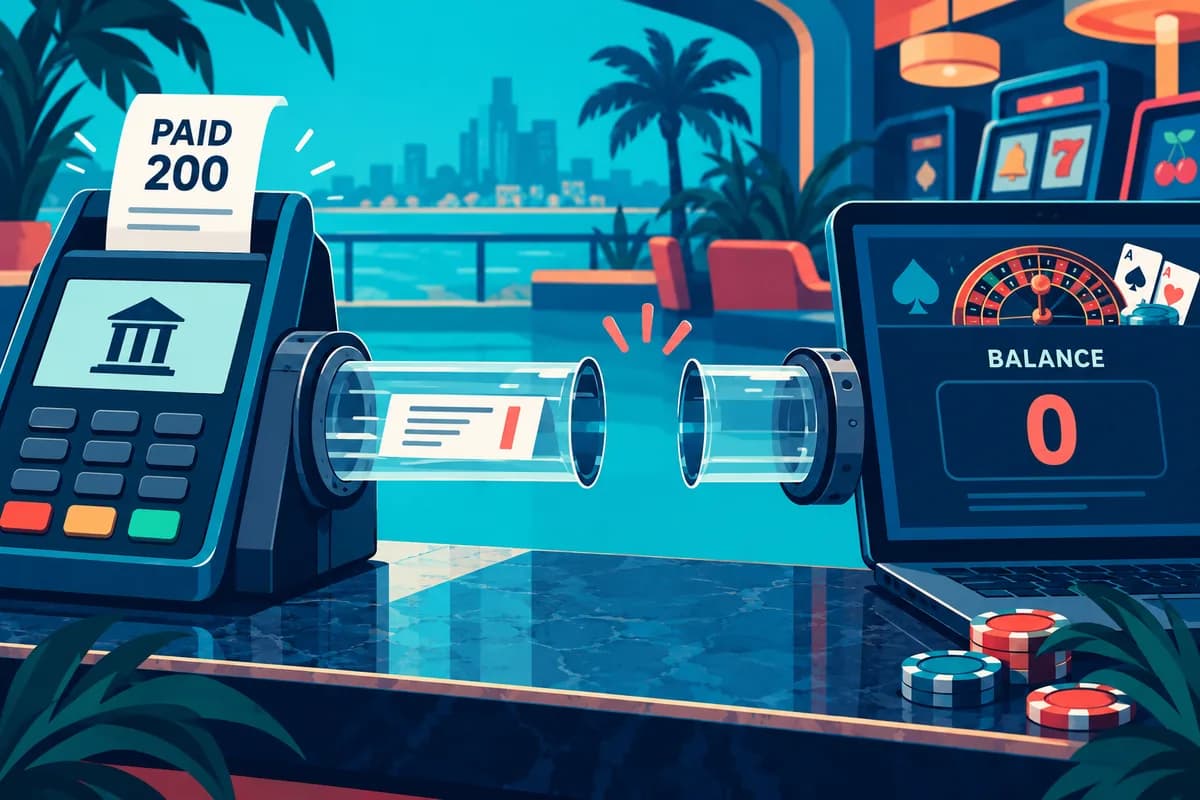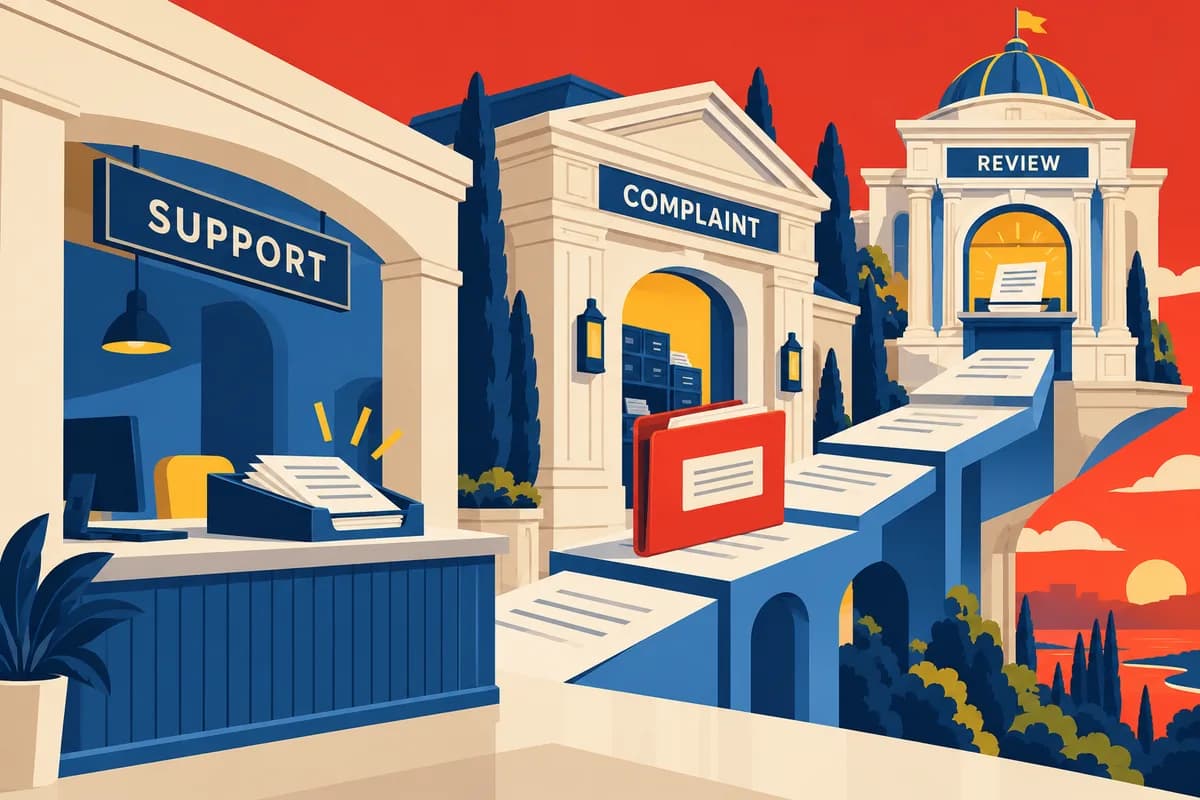

A useful casino check starts with a question more specific than “Is this site legit?” Ask whether the exact website you are using is authorised for your location, who is responsible for your balance, and what you could do if a payment went wrong. These checks cannot guarantee a good experience. They can reveal missing information before you commit money, or help you identify the correct business when a dispute already exists.
This guide is a checklist you work through yourself, in roughly the order a problem would expose each weakness. It is different from our Check casino directory, which shows the public complaint record and editorial status for operators we already track. Use both: the directory tells you how an operator has treated other players who complained, and this checklist tells you whether the paperwork behind the website holds up for you.
Step 1: Pin down the exact website and your location
Write down the full domain from your browser's address bar, not the brand name from an advert. Similar names, country versions and mirror addresses can belong to different arrangements. Do not assume a review of one domain covers another. If you arrived through an affiliate link, a social media message or a promotional email, type the address again yourself and confirm that you land on the same site.
Record the country where your account would be registered and the country from which you actually play. A page aimed at one market may not describe the conditions attached to your account. Some brands run a separate site for each licensed market and send everyone else to an international version with different terms and a different company. If the site redirects you, note the address you finished on.
Mobile apps deserve the same check. An app listing can name a developer that differs from the company running the cashier. Open the terms inside the app and compare the company named there with the one on the website.
Step 2: Identify the company and verify the licence yourself
Find the legal company name, registration number and licence information in the site's footer and terms. Then go to the regulator's official register by typing its address or searching for it directly, rather than clicking the badge on the casino page. A badge is an image; it can be copied, out of date or linked to a page that the casino controls. The Gambling Commission's business register is one primary source for British licences, and most other authorities publish some form of searchable list.
Match three things: the company, the licence and the domain. Many registers list the websites covered by each licence. If your domain is missing, that is a question to put to the operator, not automatic proof of wrongdoing; registers can lag behind new domains. Save the register link and the date you checked it. A screenshot without a date becomes less useful if the status later changes.
| What the casino shows | What to confirm independently |
|---|---|
| A licence logo in the footer | The licence number appears on the regulator's own register, with a current status |
| A company name in the terms | The same company holds that licence, not a sister company or former owner |
| A list of accepted countries | The licence actually covers players in your country, which is a separate question from being accepted |
| A “fully regulated” statement | Which regulator, which licence, and whether your domain is listed under it |
Some casinos run on a white-label arrangement: one company holds the licence and platform while another markets the brand. That is common and not suspicious in itself, but it matters later. Your complaint should go to the company responsible for your account under the terms, and the terms should say which one that is.
Step 3: Read the conditions that affect getting your money out
Open the withdrawal, identity verification and bonus terms before looking at welcome offers. Separate the casino's decision time from payment processing and arrival at your bank or wallet. A headline such as “fast payouts” tells you little if a different section says processing starts only after approval. Find the minimum, maximum, instalment rules, supported currencies and any documented fees for the method you would actually use.
Clauses worth reading twice
- Withdrawal limits per day, week or month. A low monthly cap can turn one large win into a year of instalments.
- When verification happens. Does the casino verify identity at registration, before the first deposit, or only when you try to withdraw?
- Bonus opt-in. Is a bonus credited automatically with your deposit, or do you choose it? Automatic bonuses can attach wagering rules to money you thought was your own.
- Broad discretion clauses. Wording such as “irregular play” or “at our sole discretion” deserves attention when nothing in the terms explains what it covers.
- Dormancy and inactivity fees. Check whether an untouched balance shrinks over time.
- Terms version and date. Note the date shown on the terms page. You will need it if the wording changes later.
Save a PDF or a dated screenshot of the sections that matter. Terms pages change without notice, and a dispute is far easier to argue when you can show what applied on the day you deposited.
Step 4: Check your payment route in both directions
Check whether a payment method available for deposits is also available for withdrawals. Many casinos send withdrawals back to the deposit method where they can, and some deposit methods cannot receive payouts at all. If the wording is unclear, ask support a narrow question and keep its answer: can a player in your country withdraw to that method, and what happens if it becomes unavailable?
Watch for currency mismatches. If your account is in one currency and your bank in another, conversion may happen twice, once when you deposit and once when you withdraw. If you plan to use crypto, confirm which networks are supported for withdrawals, not only for deposits.
Step 5: Ask support one question before depositing
A short pre-deposit exchange tells you more about support than any rating. Ask something with a factual answer, for example: “If I deposit by card from the UK and later request a withdrawal, how long does approval normally take, and which documents will you need?” A clear, specific answer is a good sign. A copied paragraph that does not address the question tells you how a harder conversation might go.
Keep the transcript or email. A friendly answer is useful communication, not evidence that a future payment will be completed, but it records what you were told and when.
Step 6: Look at how the operator treats players who complain
Search the casino on Check casino and open its page. Read the explanation behind its status and the linked cases rather than the total number. Look for cases that match your likely situation: a first withdrawal, repeated document requests, an account restriction or a bonus deduction. “Unrated” means a conclusion has not been established; a favourable status is not a guarantee about your account; and an empty history can simply mean a new or little-used page.
Then check whether the brand, its company or a related domain appears on the blacklisted casinos list, and read the recorded reasons. Browse public complaints for the payment method you plan to use. A case with no response is an unresolved account of events, not an independent finding, but several reports describing the same obstacle are a reason to look harder at that obstacle.
Step 7: Confirm there is a usable complaints route
Find the support address, the formal complaint procedure and the company named in that procedure. An ordinary live chat and a formal complaint may follow different processes. For MGA-licensed operators, the authority's player-protection material describes internal complaints procedures and referral to an ADR entity afterwards. That does not make every gambling regulator a service that orders individual refunds.
Read the escalation instructions as if you already needed them. Does the named body exist? Does its website identify the operator or explain which disputes it accepts? Is an old link simply broken? A missing contact does not prove fraud, but it is a practical obstacle that an attractive homepage will not solve. The escalation guide explains what each kind of body can and cannot do.
Warning signs and things that only need a question
Not every gap means the same thing. Sort what you find into two groups so that a minor issue does not get the same weight as a serious one.
| Stop and reconsider | Ask about, then decide |
|---|---|
| No company name anywhere in the terms | Company named, but the register lists a slightly different trading name |
| Licence number not found on the regulator's register | Licence found, but your exact domain is not yet listed |
| Support asks for a fee or “tax” before releasing a withdrawal | Withdrawal fees are listed in the terms for a specific method |
| Terms allow winnings to be voided for any reason without explanation | Terms include a discretion clause alongside defined examples |
| The complaints procedure names nobody and gives no address | The complaints procedure links to an ADR body whose page has moved |
What to save before your first deposit
- The exact domain and the date you checked it.
- The register entry for the licence, with the date viewed.
- A dated copy of the withdrawal, verification and bonus terms.
- Your pre-deposit support question and the answer.
- The deposit confirmation from your bank, card or wallet, once you pay.
This takes ten minutes and costs nothing. If anything goes wrong, it becomes the opening section of your case, and the evidence guide explains how to share it without exposing private information.
Turn the check into a decision
Keep a small record with four headings: exact operator, withdrawal conditions, complaint record and escalation route. Under each, write what you verified and what is still unknown. Avoid a single score that hides an unanswered question. If you cannot establish who holds your money or how a complaint would be handled, pause before depositing. Do not make a deposit simply to test whether an uncertain operator pays; a small successful withdrawal says little about how a larger one would be treated.
If your money is already held, stop treating the check as a shopping exercise. Build the account timeline and choose the guide for your problem: the delayed withdrawal guide, the blocked account guide, the KYC guide, the bonus dispute guide or the missing deposit guide. The immediate goal is a specific answer about your own funds. A clear, documented request is more useful than a general argument about whether the whole brand deserves its reputation. When you are ready to put it on record, see how complaints work here.
Email support@casinocomplaints.org with the article link and source. Editorial process →︎
Questions answered
Does a licence guarantee that my withdrawal will be paid?
No. A licence establishes a regulatory relationship and applicable obligations, not the result of an individual dispute. Check the exact operator, domain, market and current status.
What if a casino has no complaints on this site?
Treat the lack of cases as missing evidence. Check the operator and terms independently; a quiet profile does not prove reliability.
Should I deposit a small amount to test a casino?
Do not use a deposit to resolve uncertainty about an operator. Complete the identity, licence and terms checks first. A successful small payment would not guarantee future withdrawals.
The licence logo links to a certificate page. Is that enough?
No. Find the regulator’s register yourself and search for the licence number or company. A certificate page linked from the casino can be outdated or not hosted by the regulator at all.
How is this checklist different from the Check casino page?
Check casino shows the complaint record and editorial status we hold for an operator. This checklist covers what you verify yourself: the company, licence register, terms, payment route and complaints procedure.
Is a white-label casino less safe?
Not automatically. It means one company provides the licence and platform while another markets the brand. Identify which company the terms make responsible for your account, because that is where a complaint must go.
Sources & checks
Article updates2
Rewritten with a problem-focused structure, checked primary sources and clearer next steps. Original publication address retained.
Expanded and restructured around one player problem, with a new FAQ and checked sources.